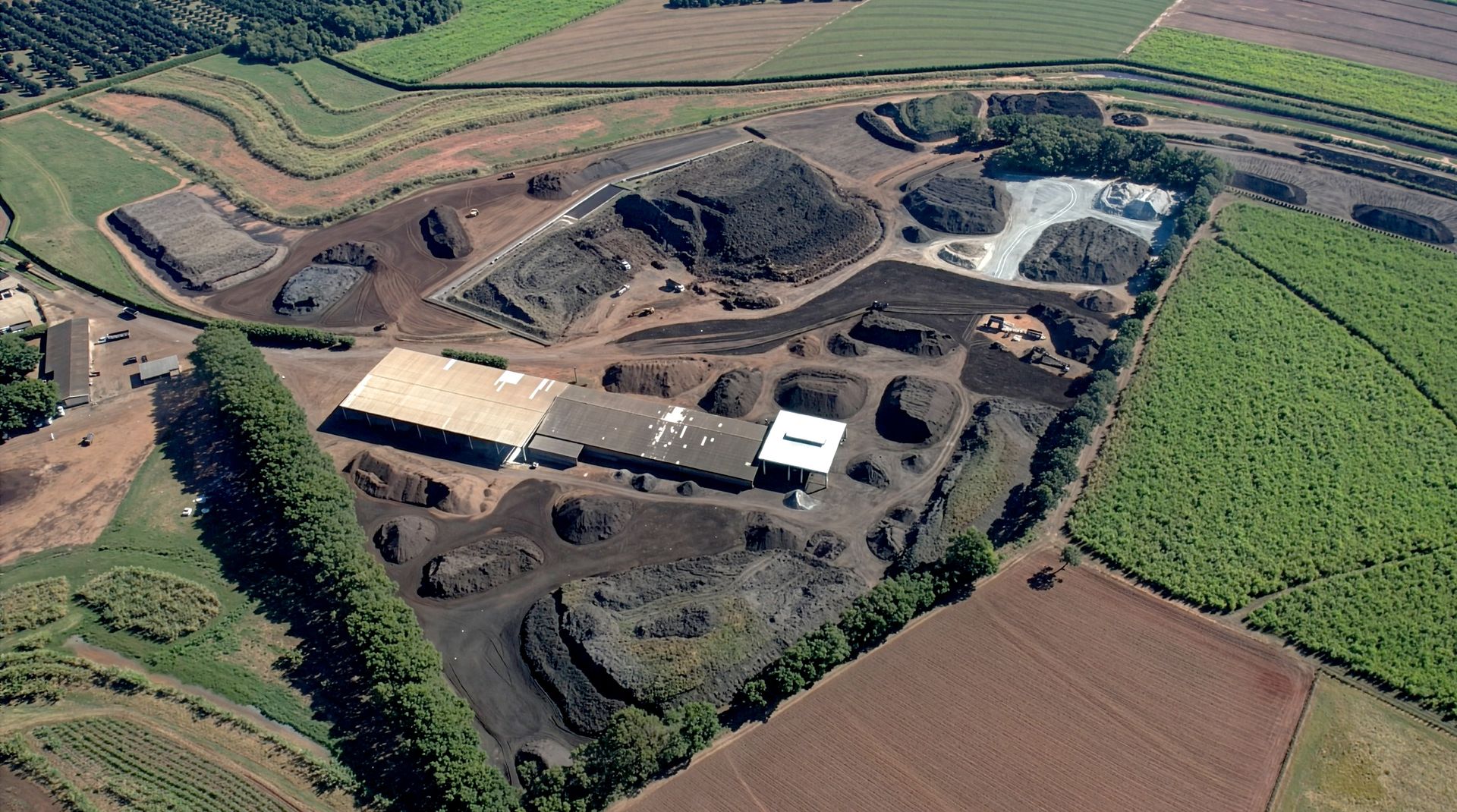
Grupo Gervino Empreendimentos is a Brazilian holding company with over three decades of experience in the production and trade of organic inputs for agriculture. Through its five companies — Visafértil, Favorita, Girardi Ambiental, Kassula, and the holding itself — the group offers organic fertilizers, biofertilizers, soil conditioners, plant substrates, raw materials for organomineral fertilizers, and composting services.
With a focus on resellers, agricultural producers, and industries in the states of São Paulo, Minas Gerais, Espírito Santo, and Paraná, the group has placed sustainability and organic production at the core of its identity since the founding of Visafértil. Pursuing the Regenera for Inputs certification was the natural next step in this journey: transforming decades of best practices into a recognized market credential.
Socioenvironmental Impact
Grupo Gervino's core activity goes beyond input production: by transforming organic waste that would otherwise be sent to landfills into high-quality fertilizers and soil conditioners, the group converts environmental liabilities into productive assets. This process directly contributes to decarbonization — reducing greenhouse gas emissions associated with waste decomposition in landfills — and provides essential inputs for implementing regenerative agriculture at scale. The Regenera for Inputs certification brings transparency and credibility to this cycle, connecting the group's environmental commitment to the growing demands for traceability and sustainability across the agrifood supply chain.
Environmental Projects
Under the leadership of Ulisses Girardi, the company's president, the group maintains a series of environmental preservation and restoration initiatives in Benedito Novo/SC, all integrated into the Visafértil Environmental Preservation project:
Atlantic Forest Preservation (Ribeirão Pinheiro, Benedito Novo/SC)
— maintenance of forest reserves focused on protecting water resources, biodiversity, genetic flow of fauna and flora, and the well-being of local communities.
Degraded Area Regeneration and Restoration (Penca, Benedito Novo/SC)
— reforestation with native species in previously degraded areas, with positive results observed in the regeneration of local biodiversity.
Spring Recovery (Ribeirão das Antas, Benedito Novo/SC)
— reforestation with native species that resulted in the spontaneous reappearance of water springs and the emergence of rich biological heritage in the region.
The Challenge
After a period outside formal certification processes, Grupo Gervino identified gaps that were primarily documentary in nature — not in the production process itself. Operations were already largely aligned with regenerative agriculture principles, but lacked the systematization, traceability, and formalization needed to be demonstrated to the market.
Two additional challenges made the situation more urgent:
Growing restrictions on access to non-GMO raw materials
that did not meet conventional organic certification criteria. Some Visafértil inputs, previously certified by IBD, lost eligibility under that scheme, requiring an alternative form of recognition.
The need to improve internal controls
, standardize processes, and strengthen traceability mechanisms — particularly relevant in a sector where input quality and provenance are increasingly scrutinized by buyers and regulators.
Motivators for Certification
The decision to pursue Regenera for Inputs certification was driven by four strategic factors:
Brand Positioning and Identity The certification was seen as a way to validate and communicate to the market practices consolidated over more than 30 years, reinforcing the group's companies' identity as producers of inputs for a fair, healthy, and sustainable agriculture.
Differentiation and Regulatory Alternative Regenerative Agriculture offered a recognition pathway for environmentally responsible producers who, in some cases, are excluded by the restrictive framework of current organic legislation — particularly regarding the use of inputs with non-GMO components.
Portfolio Value Addition The certification was viewed as an opportunity to strengthen the reputation of the group's different brands — Visafértil, Favorita, Kassula, and Girardi Ambiental — and broaden recognition of sustainable practices among clients, partners, and regulatory bodies.
Internal Process Improvement The prospect of structuring documentation, standardizing procedures, and ensuring operational traceability was a concrete motivator — certification as a management catalyst, not merely a commercial seal.
Why QIMA
Grupo Gervino's relationship with QIMA is rooted in a history of trust. Visafértil had a prior relationship with IBD, an entity that became part of QIMA — and this institutional continuity was a determining factor in the choice.
The experience during the certification process reinforced this decision. The QIMA team was recognized for:
Exemplary technical guidance from the responsible auditor, with high competence and accuracy in identifying the necessary adjustments.
A collaborative approach and availability for clarification throughout all stages, contributing to a better understanding of requirements.
Consistent support that provided confidence in implementing the required documentary and process changes.
"Whenever technical or operational questions arose, there was always availability for clarification and guidance — an important differentiator that allowed issues to be resolved throughout the entire certification process."
Certification Scope — Modules Evaluated
The Regenera for Inputs certification was obtained by Grupo Gervino in full, covering all five units of the holding simultaneously — encompassing production practices, management, and traceability of agricultural inputs in accordance with regenerative agriculture principles.
| Company | Main Activity |
| Visafértil Ind. e Com. de Fertilizantes Orgânicos | Production and trade of organic fertilizers and biofertilizers |
| Favorita Ind. e Com. de Fertilizantes Orgânicos | Production of organic fertilizers and soil conditioners |
| Girardi Ambiental Ltda. | Composting services and input industrialization |
| Kassula Ind. e Com. de Fertilizantes Orgânicos | Production of plant substrates and raw materials for organominerals |
| Grupo Gervino Empreendimentos LTDA (holding) | Management and coordination of the group's companies |
The key stages that most contributed to internal learning were those related to documentary compliance — particularly the organization of operational records, process standardization, and the creation of traceability mechanisms that previously existed in practice but had not been formally documented.
Results Achieved
Internal Impact
The certification generated concrete changes in the group's culture and processes:
Advancement in the corporate culture of process and procedure standardization.
Improvement in operational records and documentary control, with greater organization, traceability, and standardization.
Strengthening of internal management practices, with the certification process acting as a catalyst for continuous improvement.
External and Commercial Impact
On the commercial side, the certification has been broadly communicated:
Featured on the packaging of all products across the group's brands.
Actively used on social media and in prospecting and sales processes.
Referenced in interactions with regulatory bodies and in institutional presentations.
The group transparently acknowledges that the measurable impact on sales is still limited — a reflection of the still-emerging awareness of Regenerative Agriculture among consumers and the input market. The QIMA brand, heir to IBD's legacy, is still building its social capital in the national market within this segment.
Perspectives and Recommendations
Grupo Gervino identified three program development opportunities that could amplify the impact of certification:
Expand QIMA's institutional communication, highlighting the historical continuity with IBD's work, to build recognition and trust within the agricultural input market.
Translate the concept of Regenerative Agriculture in a more practical and accessible way for the different actors in the supply chain — producers, resellers, and end consumers.
Explore the growing regulatory interest in the topic: Bill No. 1,787/2025, which proposes the creation of a National Policy to Promote Regenerative Agriculture, signals a promising outlook for the sector.